Posted by Champ Metal Fabrication on | Comments Off on Champ Industries Expands Jamestown Metal Fabrication Facility
Champ Industries is expanding its Jamestown, North Dakota manufacturing facility to accommodate growing medium- to high-volume OEM production. The expansion increases the plant’s footprint from 34,000 sq. ft. to 55,000 sq. ft. by insulating and converting the existing machine shed into a functional building that connects the two facilities.
This additional floor space and rearrangement of machinery provide larger dedicated assembly and staging zones for OEMs across agriculture, construction, industrial, and energy markets. Together with Champ’s Winnipeg facility, the upgraded Jamestown plant provides dual-market capacity for buyers balancing U.S. and Canadian contract metal fabrication requirements.
Scaling Floor Space to Eliminate OEM Capacity Bottlenecks
Equipment buyers frequently face supply chain delays when scaling up program volume. By reworking the Jamestown plant layout, Champ gives expanding OEM programs room to grow without requiring new vendor onboarding.
Expanding our operational footprint allows Champ to optimize production flow in four key areas:
High-volume scaling. Streamlines shop-floor routing to handle growing program demand without risking bottlenecks.
Multi-stage assembly. Allocates continuous footprint for complex subassemblies before final shipment.
Dedicated work-in-progress (WIP) staging. Prevents shop-floor clutter and maintains material momentum between shearing, bending, and welding.
Future-proofed footprint. Provides open, modular floor space to absorb sudden shifts in OEM volume demands.
New Equipment and Capabilities Coming Online at the Sheet Metal Fabrication Jamestown Facility
Champ is integrating a Laser 1200 model alongside an automated press brake featuring automatic tool-changing capabilities. These additions complement Champ’s full-service capabilities, including CNC tube laser cutting, precision bending, robotic welding, machining, powder coating, and final assembly.
Expanding floor space ensures these high-throughput machines operate within an optimized cellular workflow rather than crowding existing lines.
These investments complement Champ’s existing metal fabrication services, which include cutting, forming, welding, machining, painting, and assembly. Champ also operates specialized equipment for tube laser cutting and metal bending. Its Jamestown and Winnipeg facilities support medium- to high-volume fabrication for OEM and Tier One customers.
The expanded sheet metal fabrication Jamestown facility gives this equipment a more efficient production environment rather than requiring the existing floor plan to absorb additional capacity.
Reducing Lead Times Through Vertical Integration
The metal fabrication capacity expansion is designed around scalability rather than one specific project. Existing customers can grow programs without automatically searching for another supplier when order volumes increase. New OEM customers gain another option for projects that need multiple in-house processes.
Multi-vendor manufacturing introduces handoff delays, transport costs, and quality assurance risks. Champ mitigates these risks by offering comprehensive in-house fabrication, including sheet and tube laser cutting, precision forming, machining, welding, powder coating, and mechanical assembly.
Managing all operations under one roof across aluminum, carbon steel, stainless steel, galvanized steel, satin-blend steel, and copper preserves tight lead-time control. Eliminating third-party processing handoffs allows Champ to guarantee transparent timelines and consistent part quality.
Project Timeline and Late Summer Milestones for Contract Metal Fabrication Canada and U.S. Programs
The expansion is projected to be finished in Q4. The former machine shed has been insulated and converted into a functional space, while work to connect it with the original facility creates a more unified production footprint.
Champ emphasizes transparent timelines as one of its core customer differentiators. That approach also applies to this expansion. Customers planning contract metal fabrication Canada or U.S. programs can discuss upcoming requirements with Champ rather than waiting until additional volume is immediately required.
Champ’s dual-facility operational model provides strategical cross-border flexibility for North American OEMs. The Jamestown facility directly fulfills domestic U.S. manufacturing demands, while the Winnipeg plant serves Canadian production requirements.
This dual-plant structure enables procurement teams to meet specific regulatory standards, including Buy America provisions in the U.S. and Industrial and Technological Benefits (ITB) commitments in Canada.
Partner with Champ for Your Next OEM Production Scale-Up
Onboarding medium- to high-volume programs requires deliberate upfront planning. Providing engineering drawings, projected annual volumes, tolerance specifications, and material preferences early allows Champ to lock in floor space and schedule machinery optimal for your production run.
Champ maintains a baseline six- to eight-week lead time for new program setups. With 21,000 sq. ft. of new operational footprint coming online in Jamestown, now is the ideal time to align your upcoming production cycles.
Ready to expand your production capacity? Contact Champ Industries to discuss future programs or schedule a plant tour, or request a quote for an upcoming fabrication program.
Posted by Champ Metal Fabrication on | Comments Off on Champ Industries Expands Capabilities by Forming The Champ Group
North American manufacturers face growing pressure to deliver complex, high-volume metal components on tighter schedules and with more exacting tolerances. Since 1967, Champ Industries has answered that challenge as a full-service fabrication and assembly partner, providing transparent timelines, consistent quality, and the ability to scale alongside OEM customers.
Now, Canerector has acquired RITZ Machine Works and merged with Industrie Lemieux, Phoenix Metal, and Champ Industries to form The Champ Group. Learn more about what this acquisition and merger means for our expanded operations, our combined service capabilities, and how it benefits the customers we serve across North America.
Why This Merger & Acquisition Matters for Our Customers
Champ Industries brings nearly 60 years of metal fabrication and assembly expertise, operating from two facilities in Winnipeg, Manitoba, and Jamestown, North Dakota. Structured for partnerships with OEMs and Tier One suppliers, our capabilities span metal bending, tube laser cutting, laser welding, automated metalworking, and powder coating. With a focus on medium-to-high volume fabrication, Champ serves diverse industries including agriculture, construction, transportation, oil and gas, and mining, while upholding ISO 9001:2015, AWS, and CWB certifications.
Industrie Lemieux brings over 35 years of stainless steel and steel fabrication expertise from its headquarters in Quebec. Their team comprises 200+ employees, operating 150,000+ square feet of production space spread out over 5 facilities in the U.S. and Canada. Their capabilities span laser cutting, bending, welding, CNC machining, passivation, and more, all geared toward high-volume OEM production for industries like mining, energy, transportation, and water treatment.
Phoenix Metal, based in Jamestown, New York, has manufactured custom metal components since 1983. The company operates three dedicated facilities focused on metal stamping, laser cutting, powder coating, welding, and electrical and mechanical assembly. Phoenix Metal holds ISO 9001:2015 and AWS certifications and serves eastern U.S. customers in the automotive, data center, HVAC, battery, lighting, and other industries.
RITZ Machine Works—headquartered in Dauphin, Manitoba, with a second facility in Cambridge, Minnesota—has specialized in precision tube and pipe bending since 1998. Other capabilities include CNC machining, laser cutting, robotic welding, metal forming, and sheet metal fabrication for customers in transportation, construction, agriculture, and mining. RITZ holds ISO 9001:2015 certification and its welders meet CWB standards.
What The Champ Group Delivers
Combining these operations under The Champ Group creates a robust manufacturing network that stretches across Canada and the United States. For our customers, this translates into measurable advantages:
Greater production capacity. Facilities in Quebec; Winnipeg, Manitoba; Jamestown, New York; Jamestown, North Dakota; Dauphin, Manitoba; and Cambridge, Minnesota allow us to absorb larger orders and manage demand spikes without compromising lead times.
Deeper material expertise. The Champ Group works with aluminum, carbon steel, stainless steel, copper, galvanized steel, and satin-blend steel. This combined material expertise goes well beyond what a single operation could cover.
End-to-end project support. Whether your project needs prototyping, high-volume stamping, precision welding, tube and pipe bending, passivation, or powder coating, you can source it all through one group. That means less vendor management overhead for your procurement team.
All four companies in The Champ Group share a common thread: a disciplined approach to fabrication quality. Champ Metal Fabrication holds ISO 9001:2015 and AWS/CWB certifications. Industrie Lemieux operates separate stainless steel and steel divisions within its facilities, with a dedicated partition wall and ventilation system to prevent cross-contamination during fabrication. Phoenix Metal earned its ISO 9001 designation in 1994, one of the first metal fabricators in the U.S. to achieve this status. RITZ Machine Works has built its reputation on ISO 9001:2015-certified precision, becoming a trusted tube bending partner to OEMs across both countries.
These credentials reflect how The Champ Group approaches production: documented processes, thorough inspection, and full traceability at every stage.
Looking Ahead: Stronger Together
The formation of The Champ Group signals our long-term investment in people, equipment, and geographic reach. We are combining the operational agility of Champ, the heavy-duty OEM production strength of Industrie Lemieux, the precision stamping and finishing expertise of Phoenix Metal, and the precision tube and pipe bending capabilities of RITZ Machine Works into a single, cohesive manufacturing organization.
For existing customers of all four companies, day-to-day operations continue without disruption. Your contacts, contracts, and production schedules remain intact. What changes is the depth of resources behind every project you bring to us.
If you are exploring a new fabrication project or looking for a partner that can handle complex, multi-stage production at scale, we invite you to connect with us. Contact Champ Industries to learn more about our combined capabilities.
Posted by Champ Metal Fabrication on | Comments Off on Reduce Supply Chain Delays With Fabricators
How To Reduce Supply Chain Delays With Fabricators
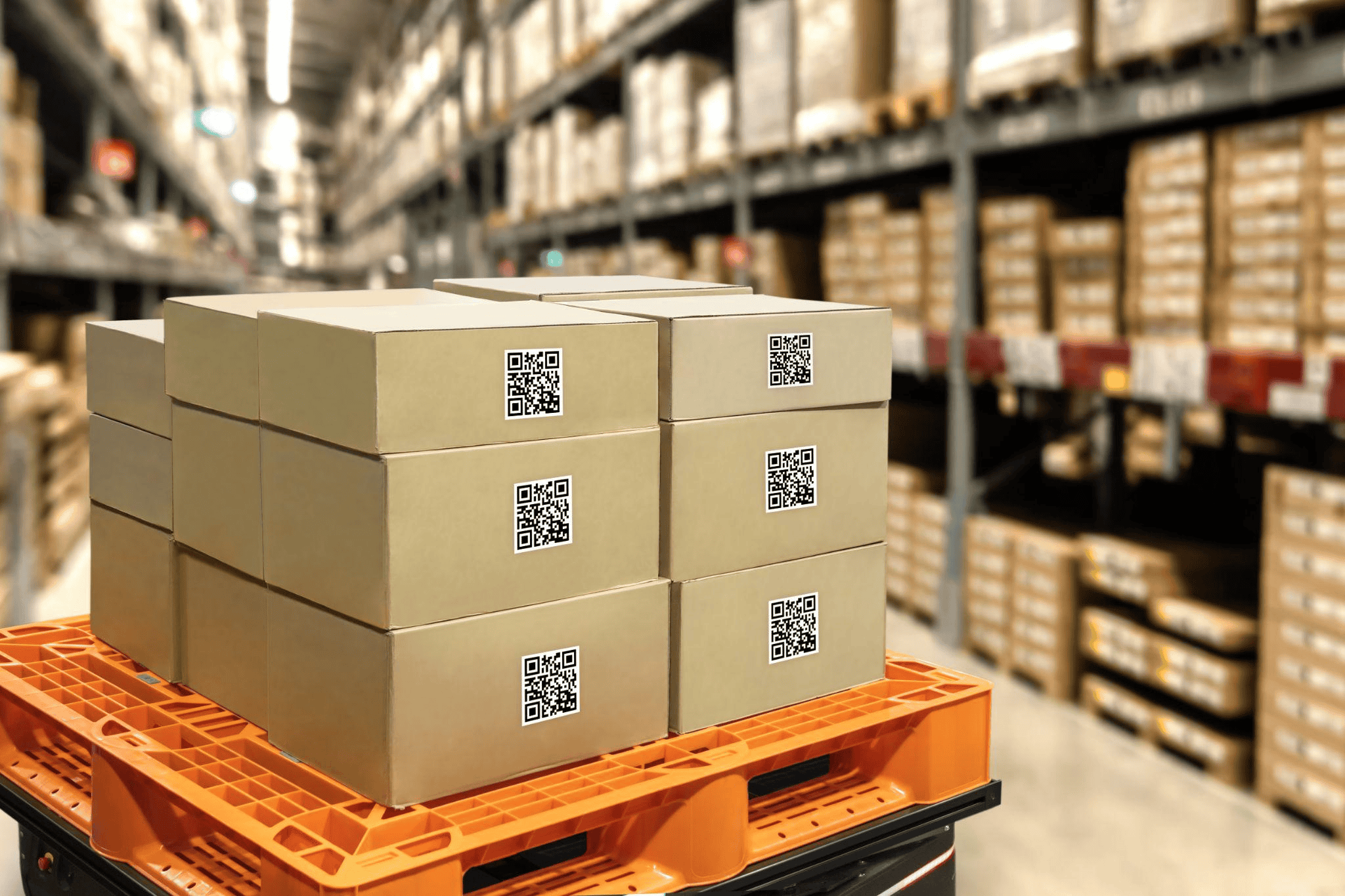
Supply chain delays are among the biggest issues that manufacturers and suppliers face for multiple reasons. However, working with the right fabricators can mitigate the risk of these delays. Specifically, regional sourcing with Champ Metal Fabrication can give you the services you need to shorten lead times to provide the products you need when you need them.
Common Bottlenecks in Supply Chains
There are several potential causes of production and supply chain delays, such as:
Complexity
As supply chains expand in scale and intricacy, they become increasingly vulnerable to bottlenecks at critical nodes, such as customs checkpoints or multi-tier supplier handoffs. For instance, logistical issues could arise, or manufacturers may need to coordinate with multiple suppliers.
Capacity and Resource Allocation Limitations
Companies may also experience longer lead times due to limited resource availability and capacity among manufacturers, including skilled labor, technology, and equipment.
Quality Control Requirements
Inefficient quality control processes can further hinder a manufacturer’s ability to deliver products on time. The right fabricator will be able to maximize quality and make it consistent across all products while keeping processes quick and efficient.
Customization
Another factor that can lead to delays is the need for customization, especially when needs change over time as businesses scale. Fabricators should be able to fulfill their customers’ needs and efficiently implement changes to keep the supply chain moving along.
Benefits of Sourcing Regionally
By working with regional metal fabricators like Champ, you can maintain a more efficient supply chain that doesn’t suffer from the above bottlenecks.
The following are the specific advantages of regionally based production and supply chain operation:
Timeliness. Regional fabrication can significantly reduce lead times, as you can bypass the need for shipping abroad.
Consistently high quality. A reputable local supplier will be able to provide you with better quality on a regular basis with each order, eliminating the need for reworks and cutting down on material waste.
Reduced risk potential. Working with suppliers overseas can increase the chance of a supply chain disruption, particularly when it comes to production and shipping.
Cost-effective delivery. Reduce shipping costs with regionally sourced parts that also keep your operations on time for more profitability.
Superior customer service. A good fabricator will also be able to provide you with customer service and support that understands and adapts to your needs.
Improved flexibility. If you need to make a change to your operations, your supplier should be able to incorporate these changes without dramatically impacting the supply chain.
How Champ Helps Keep Projects on Track
Champ Metal Fabrication works to provide OEMs and Top Tier Suppliers with a fully customized fabrication solution that works for them. In doing so, we apply our various control systems to maximize efficiency and quality at every stage.
Specifically, we offer the following to meet our customers’ needs whenever they turn to us:
Key performance indicators to measure success
Quality management system
Continuous improvement program
Employee engagement
Training and development
Customer quarterly reviews
Management goal deployment
Reduce Risk With Local Support
At Champ Metal Fabrication, our team of experienced professionals aims to provide you with everything you need from a trusted metal fabricator. Based on your particular project and order requirements, we offer several key services that deliver real results, including metal fabrication, metal bending, tube laser cutting, welding, and laser welding services.
We also operate out of two equipped facilities, with our U.S. facility based in North Dakota, while our Canadian facility sits in Manitoba. This local presence and dependable service combine to mitigate the risk of supply chain delays at all times.
Want to get started on a fabrication solution for your business? Get a quote today and find out what we can do for you.
Posted by Champ Metal Fabrication on | Comments Off on Metal Fabrication Process Explained by Expert Fabricators
From construction beams to custom enclosures, fabricated sheet metal is everywhere. But the metal you see or use didn’t start that way. Sheet metal manufacturing turns ordinary flat pieces of metal into the specific components and products that power modern equipment and machinery.
At Champ Metal Fabrication, we understand fabrication as a coordinated system of design, technology, and skilled craftsmanship. Our sheet metal fabrication processes follow a proven path that begins with design and prototyping, proceeds through material selection, cutting, and forming, and concludes with welding, coating, and inspection. With every step, we prioritize accuracy, repeatability, and efficiency so customers know exactly what to expect from design to delivery.
Keep reading to learn more about our capabilities, equipment, and workflow.
Design & Prototyping
A successful project begins with design. Our engineers use CAD software to translate concepts into detailed drawings that specify dimensions, tolerances, materials, and finishes. These digital files are the foundation for manufacturability reviews, in which we anticipate forming and fabrication challenges before production begins. Prototyping often follows, which gives customers a working sample with which to validate design decisions (or make revisions) and ensures the final product meets expectations. This upfront investment reduces costly rework and scrap later and helps speed up production.
Material Selection & Cutting
Not all sheet metal has the same mechanical properties, and this directly impacts its formability and final performance. At Champ, we work with carbon steel, aluminum, stainless steel, and specialty alloys. We carefully match each project with the right metal for its environment and application.
After selecting the right materials for the job, cutting begins with one of several operations including shearing, laser, and plasma cutting, depending on the complexity of the cuts. Laser cutting is particularly effective for achieving burr-free edges with tight tolerances, often within 0.005 inches. The result is a clean, precise blank that’s ready for forming.
Forming & Shaping
After cutting, sheets are transformed into three-dimensional parts. Press brakes with punch-and-die sets are used to bend metal into exact angles, while roll forming handles long profiles by gradually shaping them through multiple passes. This stage requires advanced equipment and skilled operators who understand the material’s behavior under stress.
Whether creating a series of uniform bends or fabricating a curved profile, forming turns flat sheet metal into components that are structurally sound and ready for assembly.
Tools, Machines, and Staff Involved
Behind every finished part is a combination of high-tech equipment and highly trained people. Champ Metal Fabrication invests in both.
Our production floor includes CNC lasers, turret punches, routers, and hydraulic press brakes that are programmed with G-codes that guide the machines and ensure a highly repeatable process. Additional equipment, such as mills, lathes, and drills, performs precision machining where required.
Welding stations support MIG, TIG, spot, laser, orbital, and arc welding, allowing us to join components with strength and consistency. Finishing tools handle grinding, coating, and surface treatments to complete the product.
But machines are only part of the process. Engineers validate designs and program tool paths. Machine operators oversee cutting and forming. Welders ensure assemblies meet structural standards. Quality assurance technicians inspect every dimension, weld, and finish before parts leave the floor. It’s this collaboration of people and technology that ensures success.
Timeline and Project Flow
A typical Champ project begins with sourcing material, which usually takes three to seven days, depending on availability. Cutting, forming, and welding are often completed within one to two weeks for standard jobs. Finishing, such as powder coating or painting, may add a few additional days.
Custom projects, specialty finishes, or complex assemblies can extend timelines to six to eight weeks. Prototyping, sourcing rare materials, or coordinating with outside vendors may also add to the timeline. That’s why early RFQ submissions and clear communication are so important.
One advantage Champ Metal Fabrication offers is that everything happens under one roof: design, fabrication, welding, finishing, and inspection. This eliminates the delays that often occur when multiple vendors are involved. By streamlining handoffs, we keep projects on schedule and reduce the risk of errors.
Understand What to Expect With Champ
Sheet metal fabrication projects work best when they are treated as a partnership between fabricators and their customers. At Champ Metal Fabrication, our approach to sheet metal fabrication ensures precision at every stage, from CAD models to final delivery. By combining advanced technology, skilled staff, and efficient project flow, we deliver parts that meet specifications, deadlines, and quality standards.
Whether you’re seeking help with material selection, need a reliable partner for high-volume runs, or want support for a custom prototype, our team is ready to guide you through the process. Contact us today to get connected with a member of our team for more information.
Posted by Champ Metal Fabrication on | Comments Off on Things To Consider When Choosing Industrial Metal Fabricators
Selecting the right industrial metal fabricator can significantly impact the success of your project. Whether you’re building custom components or large-scale assemblies, it’s essential to vet each potential partner based on their capabilities, certifications, and regional knowledge. This checklist will help you find the right industrial metal fabricator for your next project.
Core Capabilities to Look For
When evaluating industrial metal fabricators, look for a shop that can support your project from prototyping through finishing. In addition to streamlining your production process, full-service capabilities help reduce delays, communication errors, and quality issues. A fabricator’s core services reflect their ability to move projects smoothly through each phase, which will save you time without sacrificing quality.
Here are some core capabilities to look for in an industrial metal fabricator:
Prototyping and first-article services.
A reliable partner will offer prototyping to test form, fit, and function before scaling to production.
Cutting and machining technology.
Look for a fabricator with advanced equipment, such as high-capacity punches and CNC laser cutters for tube and sheet metal. These technologies enable precise cuts and reduce waste, especially important for complex geometries.
Forming and bending expertise.
Press brakes, rollers, and custom tooling allow a fabricator to create specific angles and radii, which are critical for industries like aerospace, defense, and energy.
Welding and assembly services.
MIG, TIG, and spot welding should be part of the shop’s in-house capabilities. Ask about their process qualifications and whether their welders hold certifications.
Finishing options.
In-house painting, powder coating, or anodizing helps avoid delays that often occur when outsourcing finishing. Performing these processes under one roof also supports consistency in appearance and durability.
Material versatility.
A capable shop should demonstrate experience with several types of metals, including aluminum, stainless steel, carbon steel, and exotic alloys.
Regional Expertise and Certifications
Selecting a fabrication partner with the right credentials and regional presence can influence both compliance and efficiency. By choosing a certified and regionally aligned shop, you reduce risk and gain peace of mind that your components will meet all regulatory and quality requirements.
Here are some things to look for:
ISO 9001:2015 certification.
This globally recognized quality standard verifies that the fabricator adheres to best practices in process control, documentation, and continuous improvement. It can also streamline vendor approvals and reduce the need for third-party audits.
Welding certifications.
Look for credentials from the American Welding Society (AWS) or the Canadian Welding Bureau (CWB). These certifications demonstrate that the fabricator meets safety and quality benchmarks for weld integrity.
Local presence and logistics.
A regional shop offers faster lead times, easier project oversight, and reduced freight costs. For companies operating across North America, partners with a presence in both the U.S. and Canada provide added flexibility and reduced shipping risk.
Cross-border compliance.
Your fabricator should be familiar with regulatory frameworks such as the U.S. Buy America Act or Canada’s Industrial and Technological Benefits (ITB) policy. This ensures your parts meet procurement rules for government contracts or large infrastructure projects.
Questions to Ask Before Hiring
Performing due diligence is essential before entering a long-term fabrication partnership. Asking the right questions can help you assess whether the shop is truly capable of meeting your technical and operational needs.
We’re providing some questions to ask when you are looking for an industrial metal fabricator. The answers to these questions will reveal a great deal about a fabricator’s transparency, professionalism, and ability to communicate effectively. Many people underestimate the importance of these qualities relative to technical skills.
What are your typical production volumes?
Ensure the shop can handle your project size, whether it’s low-volume prototyping or high-volume runs.
What is your quality assurance process?
Ask how they inspect raw materials, monitor in-process parts, and handle final inspections.
What information do you need to provide an accurate quote?
A reliable fabricator should request specific data from you—such as CAD files, tolerances, and delivery timelines—to provide precise estimates.
Can I tour your facility?
If they say no, that may be a red flag. An on-site visit will show you a lot about the shop’s cleanliness, organization, and equipment quality.
How do you manage your raw material supply chain?
Understanding their sourcing and inventory practices can help you avoid delays.
Can you share customer case studies or references?
A metal fabricator with a track record and case studies in your industry is more likely to anticipate and solve your project’s unique challenges than a generalist.
Choose Champ for Your Next Industrial Fabrication Project
When choosing an industrial metal fabricator, trust a partner with the right experience and equipment. At Champ Metal Fabrication, we bring these key aspects to every project. With advanced in-house capabilities, decades of combined expertise, certified welders, and a deep understanding of North American compliance requirements, we’re ready to be your go-to partner for precision metal fabrication.
Are you ready to start your next custom fabrication project? Get a quote today and see how Champ delivers excellence from prototype to production.
Posted by Champ Metal Fabrication on | Comments Off on Top Industrial Applications: Laser Tube Cutting
Click to Expand
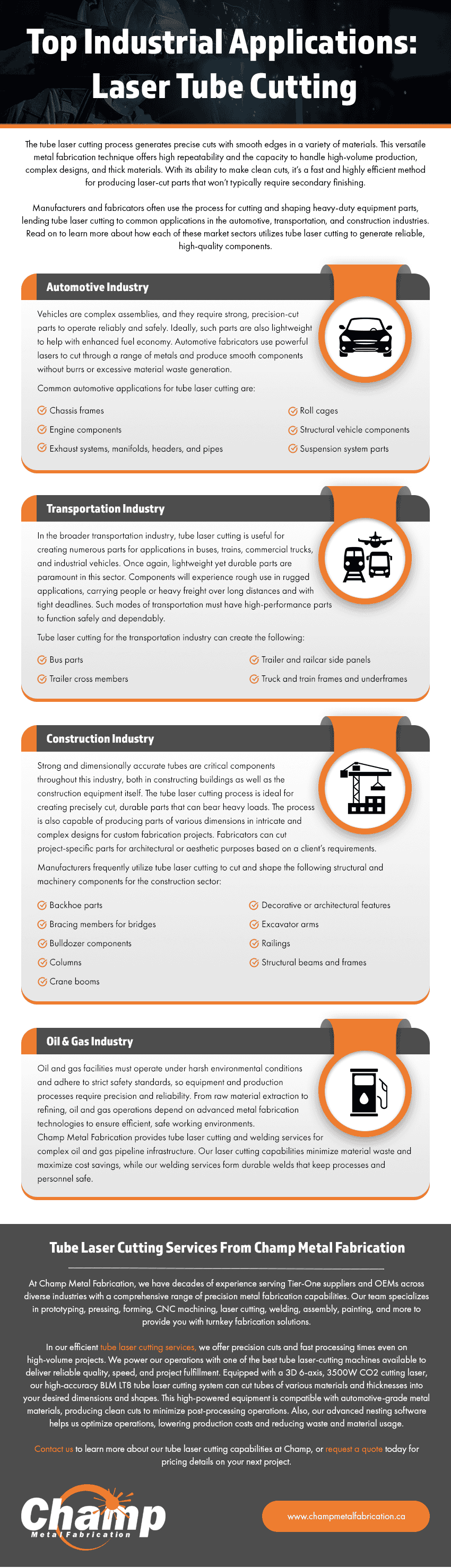
The tube laser cutting process generates precise cuts with smooth edges in a variety of materials. This versatile metal fabrication technique offers high repeatability and the capacity to handle high-volume production, complex designs, and thick materials. With its ability to make clean cuts, it’s a fast and highly efficient method for producing laser-cut parts that won’t typically require secondary finishing.
Manufacturers and fabricators often use the process for cutting and shaping heavy-duty equipment parts, lending tube laser cutting to common applications in the automotive, transportation, and construction industries. Read on to learn more about how each of these market sectors utilizes tube laser cutting to generate reliable, high-quality components.
Automotive Industry
Vehicles are complex assemblies, and they require strong, precision-cut parts to operate reliably and safely. Ideally, such parts are also lightweight to help with enhanced fuel economy. Automotive fabricators use powerful lasers to cut through a range of metals and produce smooth components without burrs or excessive material waste generation.
Common automotive applications for tube laser cutting are:
Chassis frames
Engine components
Exhaust systems, manifolds, headers, and pipes
Roll cages
Structural vehicle components
Suspension system parts
Transportation Industry
In the broader transportation industry, tube laser cutting is useful for creating numerous parts for applications in buses, trains, commercial trucks, and industrial vehicles. Once again, lightweight yet durable parts are paramount in this sector. Components will experience rough use in rugged applications, carrying people or heavy freight over long distances and with tight deadlines. Such modes of transportation must have high-performance parts to function safely and dependably.
Tube laser cutting for the transportation industry can create the following:
Bus parts
Trailer cross members
Trailer and railcar side panels
Truck and train frames and underframes
Construction Industry
Strong and dimensionally accurate tubes are critical components throughout this industry, both in constructing buildings as well as the construction equipment itself. The tube laser cutting process is ideal for creating precisely cut, durable parts that can bear heavy loads. The process is also capable of producing parts of various dimensions in intricate and complex designs for custom fabrication projects. Fabricators can cut project-specific parts for architectural or aesthetic purposes based on a client’s requirements.
Manufacturers frequently utilize tube laser cutting to cut and shape the following structural and machinery components for the construction sector:
Backhoe parts
Bracing members for bridges
Bulldozer components
Columns
Crane booms
Decorative or architectural features
Excavator arms
Railings
Structural beams and frames
Tube Laser Cutting Services From Champ Metal Fabrication
At Champ Metal Fabrication, we have decades of experience serving Tier-One suppliers and OEMs across diverse industries with a comprehensive range of precision metal fabrication capabilities. Our team specializes in prototyping, pressing, forming, CNC machining, laser cutting, welding, assembly, painting, and more to provide you with turnkey fabrication solutions.
In our efficient tube laser cutting services, we offer precision cuts and fast processing times even on high-volume projects. We power our operations with one of the best tube laser-cutting machines available to deliver reliable quality, speed, and project fulfillment. Equipped with a 3D 6-axis, 3500W CO2 cutting laser, our high-accuracy BLM LT8 tube laser cutting system can cut tubes of various materials and thicknesses into your desired dimensions and shapes. This high-powered equipment is compatible with automotive-grade metal materials, producing clean cuts to minimize post-processing operations. Also, our advanced nesting software helps us optimize operations, lowering production costs and reducing waste and material usage.
Contact us to learn more about our tube laser cutting capabilities at Champ, or request a quote today for pricing details on your next project.
Posted by Champ Metal Fabrication on | Comments Off on Six Benefits of Contract Metal Fabrication
Click to Expand
Metal fabrication services encompass the cutting, bending, and shaping techniques manufacturers use to produce metal parts and products for diverse industries. While standard components may suit the needs of some applications, working with a contract metal fabricator gives you greater options for creating a product tailored to the unique requirements of your specific design or project. Read on to learn more about metal fabrication, the five primary benefits of contract services, and how partnering with an experienced contract fabricator can elevate your project.
What Is Metal Fabrication?
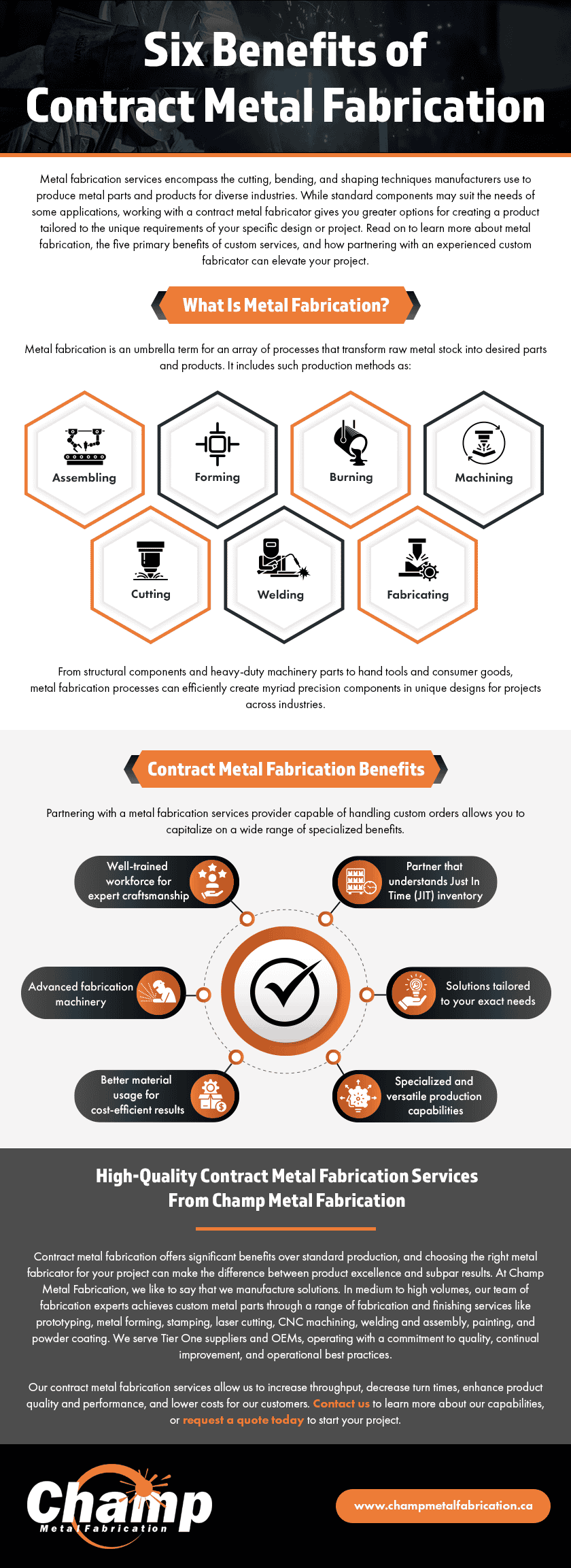
Metal fabrication is an umbrella term for an array of processes that transform raw metal stock into desired parts and products. It includes such production methods as:
Assembling
Burning
Cutting
Fabricating
Forming
Machining
Welding
From structural components and heavy-duty machinery parts to hand tools and consumer goods, metal fabrication processes can efficiently create myriad precision components in unique designs for projects across industries.
Contract Metal Fabrication Benefits
Partnering with a metal fabrication services provider capable of handling high-volume orders allows you to capitalize on a wide range of specialized benefits.
SOLUTIONS TAILORED TO YOUR EXACT NEEDS
The ultimate benefit of contract fabrication is that you’ll receive components created with your specific application in mind. You won’t have to compromise on your design or make do with standard parts. The alternative — working with just any fabrication shop and having to default to standard dies, tooling, machinery, and processes — can negatively impact your project and impede your brand’s reputation as an innovator. With contract fabrication, the specialists will be able to evaluate your design and create precision components with tight tolerances for an exact fit.
SPECIALIZED AND VERSATILE PRODUCTION CAPABILITIES
Using just any standard manufacturing method for your production run may be detrimental to your product results, so it’s important to apply the fabrication techniques that make the most sense for your project. With contract metal fabrication, you’ll gain access to a broad spectrum of specialized processes, such as precision waterjet cutting, for creating parts in exactly the right shape and size per your specifications. To support the success of your project, find a contraction metal fabrication partner with the relevant capabilities to produce your unique or complex product.
ADVANCED FABRICATION MACHINERY
In metal fabrication, high-quality equipment delivers superior results. Metal shops that only offer standard production often won’t invest in higher-end machinery due to its cost, limiting their ability to provide you with quality products and customized solutions. Contract metal fabricators, however, typically equip themselves with advanced fabrication machinery capable of making custom cuts. This enables them to deliver tight-tolerance parts with heightened precision, efficiency, and speed.
A PARTNER THAT UNDERSTANDS JUST-IN-TIME (JIT) INVENTORY
Just-in-Time inventory minimizes inventory storage expenses and prevents waste from excess production. A partner experienced in JIT can drive improvements in both productivity and lower operating costs.
WELL-TRAINED WORKFORCE FOR EXPERT CRAFTSMANSHIP
Contract work requires a great deal of skill and expertise to execute. To find the right service provider for your project, look for a metalworking team with the qualifications and experience necessary to create specific projects, no matter how intricate or complex the design. Reputable fabricators should also be able to assist you should you have questions about the ideal metal for your project, potential design optimizations, cost-saving opportunities, and more.
BETTER MATERIAL USAGE FOR COST-EFFICIENT RESULTS
While steel fabrication parts are common for their strength and durability, the metal fabrication process is compatible with an array of metals. Contract fabrication service providers often have close, long-standing relationships with various metal distributors for procuring high-quality metals. This gives them the benefit of sourcing your preferred materials in smaller quantities or at lower, discounted prices than you could have yourself, with the fabricator passing those savings and benefits on to you. Custom metalwork generally produces less waste, as well, reducing material costs.
High-Quality Contract Metal Fabrication Services From Champ Metal Fabrication
Contract metal fabrication offers significant benefits over standard production, and choosing the right metal fabricator for your project can make the difference between product excellence and subpar results. At Champ Metal Fabrication, we like to say that we manufacture solutions. In medium to high volumes, our team of fabrication experts achieves high-quality metal parts through a range of fabrication and finishing services like prototyping, metal forming, stamping, laser cutting, CNC machining, welding and assembly, painting, and powder coating. We serve Tier One suppliers and OEMs, operating with a commitment to quality, continual improvement, and operational best practices.
Our contract metal fabrication services allow us to increase throughput, decrease turn times, enhance product quality and performance, and lower costs for our customers. Contact us to learn more about our capabilities, or request a quote today to start your project.

 Supply chain delays are among the biggest issues that manufacturers and suppliers face for multiple reasons. However, working with the right fabricators can mitigate the risk of these delays. Specifically, regional sourcing with